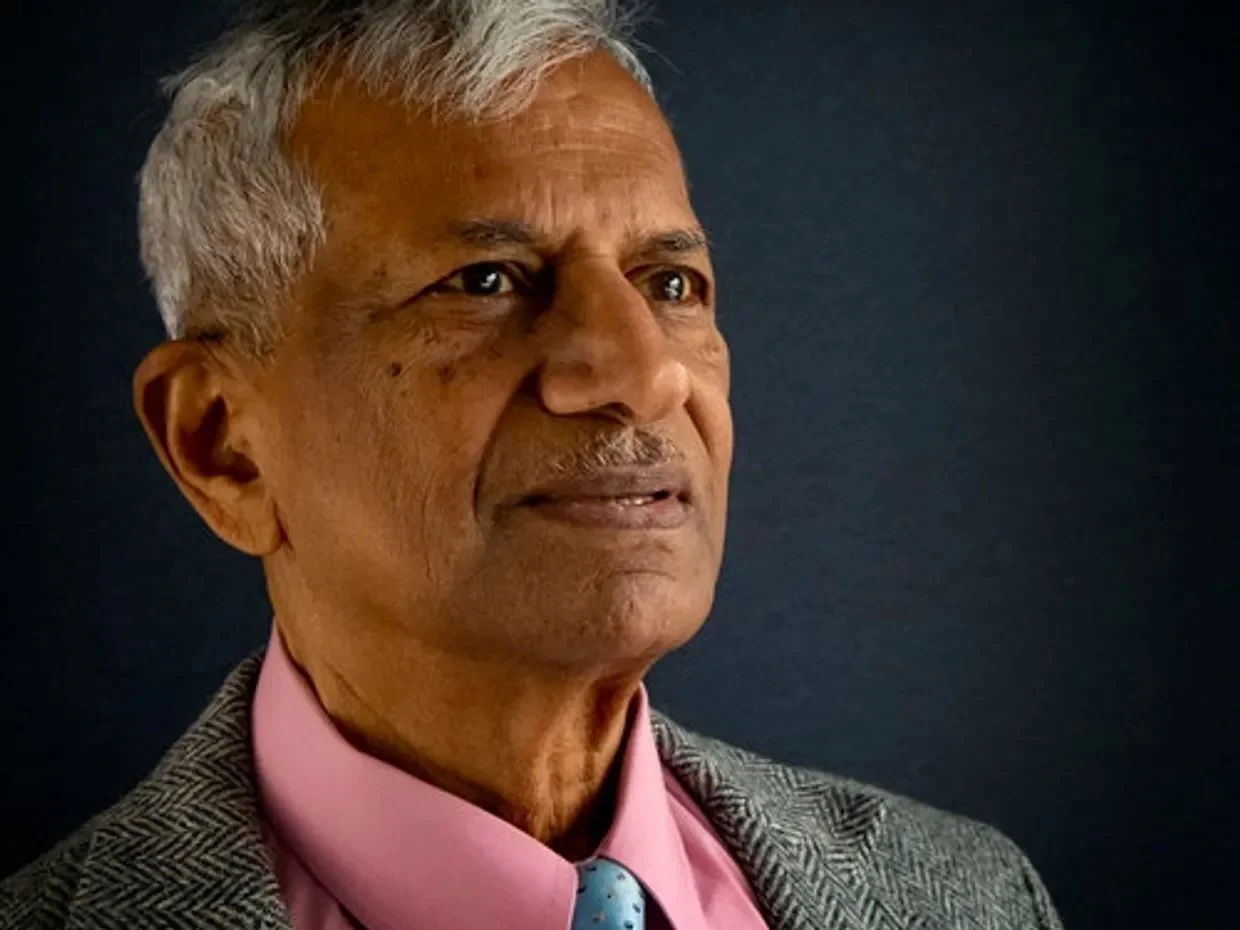
My Conversation with S.V. Rama Rao
I failed to write a blogpost in our Shut Up & Write session, on Tuesday, because I was working on deadline, creating the program booklet for Easton Book Festival. Today, I was thinking about a conversation I had 24 years ago with S.V. Rama Rao, which I wrote down a year afterward, in 2002. I’m posting it here—I think it does relate to the topics in my newest book…why not share it? I see from Wikipedia that he is now 90 years old! I have not connected with him since that meeting in India.
Rama
Tim and I sat opposite one another on the train to Piduguruwala. Next to me sat an older, casually-dressed Indian man. After the train started up, he commented on the long wooden bansuri flute sticking out of my bag – Tim and I had each bought flutes in Delhi. The man asked if I knew how to play it – and then requested that I demonstrate. I noodled for a little while – and put the flute back. As required, the man was complimentary and asked if I’d studied the bansuri flute. I told him I hadn’t, but since my last trip to India I’d fantasized about coming back to study. Now wasn’t the time, however. He asked when I’d been to India before. When I said Twenty Years, he appeared to disbelieve me. I must say, I almost disbelieved myself – it HAD been longer than I was used to thinking of it as being.
By this time, the train was speeding through a blazingly sunlit landscape of fields planted in cotton and chili peppers. All the windows were open to allow some air circulation to relieve the stifling heat – and the rattling of the car was very loud. So – as our conversation continued, we each began to speak louder and louder. Gradually we found ourselves forced to shout directly into each other’s ears. I would turn my head, he would put his mouth up to my ear, and shout his question or comment. Then he would turn his head, I would put my mouth right up to his ear, and I’d shout my response or question. We continued this for three hours – the length of the train ride.
Each exchange seemed to elicit some reason for surprise and amazement from both of us – because it was one of those Six Degrees Of Separation encounters – where you meet someone with whom you have many different layers of relationship already, but who you’ve never known existed.
“Why were you in India twenty years ago?”
“My wife and I spent a year in Asia.”
“Where did you visit?”
“We started in Indonesia, then we visited Singapore, Malaysia and Thailand. We went to Japan and taught English – I had children, teenagers and businessmen as students. I studied Shakuhachi, and my wife studied pottery.”
“This is where you learned to play flute?”
“No, I was already a jazz flute player. Studying shakuhachi was a remarkable experience though because the teacher approached the process of teaching without telling me anything. When I studied flute in the United States, we used sheet music and the teacher told me how to hold the flute, how to place my fingers, how to use my lips and so on. But in Japan the teacher sat opposite me and played the music on the table between us – and never said a word to me. All I could do was take from the teacher whatever I could, by observing – so that my actions were never corrected by the teacher. So really I was teaching myself.”
“Then you’ve learned the true relation between a teacher and a student. This is the lesson of all the Guru and Disciple traditions – that there is no difference between the Guru and Disciple. They have been born into different generations – that’s all.”
“Yes, it seems that this is a very difficult thing for people to grasp, isn’t it?”
We looked at each other.
I asked him, “Where are you going now?”
“I’m going to visit the village of my birth. I come every year now.”
“Where do you live?”
He said, “I live in Chicago.”
This certainly took me by surprise. “I live in Chicago too!”
He smiled. “Really! And why have you come here this time, then?”
“My brother-in-law and I have launched an internet business to attract capital from schoolchildren and families into backing microcredit loans for poor women to start small businesses. You know that anyone can invest in Notes to underwrite these loans and even receive interest while their money is invested in this way. Microcredit loans help women to take control of their lives, freeing them from local moneylenders who charge very high rates of interest. The idea is a group of women gets some loan capital, and half the women use the money for their businesses, and as they repay their loans the other women in the group immediately use this repaid money as capital – so the peer-pressure and mutual support inside the group help all of them to keep their enterprises solvent and the funds re-circulating.”
He said, “Yes, I know this method very well. I was an economics professor for 18 years in the United States.”
“Are you still teaching economics?”
“No, I’ve retired. Now I only teach when I come to India each year.”
“Where do you teach in India?”
“I tour from university to university as a guest lecturer.”
“What is the subject of your lectures? Economics?”
“Not specifically. Yes, certainly I talk about economics. But since I’ve been living in the United States for so many years the students are naturally most curious about life there. They all want to know why America is so rich and India is so poor.”
“What do you tell them?”
“Well, I try to lead them to find out for themselves – to search for differences that could explain this.”
“Do you find that many of your Indian students offer interesting explanations? What sorts of things do they say?”
“Most of them believe there are some sort of cultural differences that make it hard for Indians to make money like Americans do. That American culture provides a better inspiration for making money. They feel that Indian culture is spiritually superior, and that this causes problems with making money.”
“And what do you tell them?”
“I tell them that Americans have no advantage culturally when it comes to money – that India could be just as rich as America.”
“Do they argue with you?”
“Yes, of course they don’t agree with me. They say that clearly America is rich, so that proves it’s a better place to make money – and this is why so many of them want to go to America – so they can escape the poverty in India.”
“What is your suggestion to them? Why don’t you agree with them?”
“I tell them that the only difference between India and America is corruption.”
“Corruption? But there’s corruption in America too.”
“The corruption in India is much more deeply embedded. It operates at every level, in every transaction. In order to do business in India you must maintain personal relationships – you must have personal connections. This impedes economic activity, since many transactions are unavailable to many people. Without a personal relationship to permit the economic transaction, they have to pay bribes, or inflated prices – or they can’t get the licenses or permits at all. They’re simply blocked by officials or businesspeople who are protecting the existing systems and players.”
I said, “But if this is true – that corruption is so bad in India that it slows the economy down and leaves everyone poor – then aren’t the students right that India will always remain poor?”
“I tell them it’s up to them to end the corruption. Only if they take on this task of fighting corruption whenever they encounter it can India escape poverty.”
“So that’s why you continue to lecture on this subject to college students? To motivate the new generation to fight corruption? This is how you’re fighting poverty in India?”
“I spend several months each year, when I can, lecturing on this subject – I’ve been doing this for a number of years.”
“Are your lectures well attended? How is your message received?”
He said, “Everyone wants to know why America is so rich and India is so poor. All the students agree that corruption is a terrible problem here – but many have never understood the problem as so fundamental and influential, because they’re so used to it. Since they haven’t been able to step back and see the situation for what it is, they haven’t considered how to attack it. Since they know I’ve been living in America for so long, they listen to what I have to say about the true difference between India and America. They’re so used to thinking Americans are smarter or better at business that it comes as quite a revelation that this isn’t the case – and that there’s something they can do to make India just as successful economically as America.”
I said, “What led to you come to America? Did you study economics in India?”
“I am an artist. I became an economics professor later. I left India and went to Paris in the 1950s.”
He took out a portfolio from a briefcase and showed me some photographs of paintings – they looked quite modernist – somewhere between Matisse and Miro.
“I became quite a well-known painter – some of my paintings are in the Tate Gallery in London. When I first came to America it was as a painter.”
I looked through the pages of the portfolio.
“These are marvelous – have you continued painting?”
“Occasionally now – but I went into economics in the early 1960s – I taught in Kentucky and then I came to Chicago – I raised a family. Here’s a photograph of my daughter – she’s studied for years with quite a well-known dancer. Have you heard of her? Heem?”
I had never heard of Heem in Chicago – but just a week before, when I’d been talking with some women who worked for the United Nations, in Delhi, and had described our project of using stories from children in India in a theatre show for Chicago children, one of these women had said, “You have Heem! She would surely be helpful in bringing these stories to the stage.” When I’d asked her who Heem was, she’d been shocked. “You live in Chicago and you haven’t heard of Heem! She’s one of the greatest dancers in the world – a leader in the world of traditional Indian dance.”
Now, on the train to Piduguruwala, here was this man telling me Heem was his daughter’s teacher! I told him about my conversation with the United Nations woman in Delhi. He laughed.
“Yes, you should contact her when you get back. She has been teaching children and young women for over twenty years – her school is quite well known. Here is a brochure from her school.” He handed me an elegant full-color piece of literature describing Heem’s school. One of the teaching sites was just a mile from where The Children’s Bookstore had been!
I said, “I can’t believe I’ve never heard of her. I’ve been a performing artist and bookseller in Chicago for twenty years, and I’ve presented many performers from cultural traditions around the world in my store and at street festivals.”
He said, “Well, do you know Corky Siegel?”
“I’ve heard him play – he used to come to a jazz club across the street from my children’s bookstore called Orphan’s. And he’s played at a jazz club called Joe’s Bebop, next to the store I have now at Chicago Children’s Museum, on Navy Pier.”
“You operate a store on Navy Pier? We held the wedding for another daughter of mine in the Grand Ballroom at Navy Pier a few years ago! My friend L. Subramanian played violin at the wedding.”
I said, “You’re friends with L. Subramanian?! I love his work. Subramanian introduced traditional Indian violin-playing to the West.”
He said, “We’ve been friends for a long time. In fact, I just saw him a few days ago – in Delhi.”
“So, you were in Delhi last week as well? I thought you were on a lecture tour.”
“Not yet on this trip – I was in Delhi on Republic Day when the earthquake struck. All the festivities were cancelled and have been rescheduled for a few months from now. So I changed my plans and took the opportunity to come down here now.”
“What brought you to Delhi on Republic Day?”
“I am being honored with an award by the President. L. Subramanian and I have been named “Living Treasures” by the government of India.”
I’d heard of this designation – it’s also awarded in Japan. Leading artists and cultural figures – whose importance is regarded in many countries as far out-weighing other leaders in society – will be named a “Living Treasure” to convey the extreme regard held for them in their country. It’s a peculiarly high honor. There’s no award in the United States of this sort – even our highest awards don’t convey anything remotely like the respect associated with such “Living Treasure” designation.
I became silent, and we just rode the train for a few minutes.
I said, “Does much of your family remain in your birth-village?”
He laughed, “Oh yes. I have quite a large family. It’s a pleasure to visit them each year, especially because for a number of years I wasn’t able to. I’ll spend a month or so there. By the way, since you’re so interested in India, do you know Wendy Doniger?”
“I don’t know her particularly – but I did ask her to take me on as a graduate student 15 years ago. Shortly before my wife and I opened our first bookstore – The Children’s Bookstore -- I’d decided that after that store opened I’d begin a degree studying the nature of musical improvisation, comparing Indian flute traditions and American jazz traditions.”
“Was she receptive?”
“She was quite friendly, but she thought it was odd that I wanted to focus on Indian music when I’d studied shakuhachi in Japan, and especially since I hadn’t learned Sanskrit -- only Japanese, Arabic, French, Spanish and German. I told her I planned to learn Sanskrit, and to return to India to study bansuri flute, in conjunction with my research. She suggested I apply in the South Asian Studies Department. I explained that I was applying to the inter-disciplinary Social Thought program she was helping supervise because of the jazz aspect of my thesis. She was unsure if this program would be quite right for me.”
“Well, did you go to the South Asian Studies Department? What happened?”
“I was crazy to think I could start this degree at the very time we were opening our bookstore. I never followed the idea up.”
He said, “Maybe another time. But, if you were so interested in India, why did you open a Children’s Bookstore?”
“We did originally plan to open a sort of third-world travel and anthropology bookstore, like several we’d seen in Paris -- when we lived there after leaving Japan. But we decided Chicago couldn’t support a store like that. We followed another set of leads into children’s bookselling.”
He said, “You should have contacted my friend Shantilal – he’s a publisher in Delhi who does quite a bit of business with American bookstores. He could have guided you perhaps.”
“Shantilal? Is he connected to Motilal Banarsidas? Is that the name of a person?”
“Of course – Motilal Banarsidas. Have you heard of their books?”
“Motilal Banarsidas was the first publishing house to extend us credit – we used them on all our credit reference sheets for years. They were the only house that didn’t demand another house as prior reference. I loved their reprint of Hsuan Tsang’s “Si Yu Ki” – I bought it in Paris.
“Shantilal is a wonderful man. You should call on him when you return to Delhi.”
“I suppose I won’t be able to find time.”
We rode in silence. I kept puzzling over this strange overlapping set of networks from my past that seemed to have suddenly linked up.
Finally I said, “You know what’s most perplexing for me about being in India – and I don’t know what your perception of this is, since you’ve lived for so long both in India and the West – is when I’m in America, everyone around me knows for an absolute certainty, without any question in their minds, and in complete agreement with everyone else around them, that they are now living a unique life. That is – each person is born, lives, and dies – and that this happens one time. And that therefore each thing that happens during this one life is of enormous importance, since life is so short. While there are varying ideas of what happens after death – the basic idea of Only One Life is a background idea that nearly everyone has in America. But, when I’m here in India, everyone around me knows for an absolute certainty, without any question in THEIR minds, and in complete agreement with everyone else around them, that the life they are now leading is only one in a string of millions or billions of past and future lives. So that anything that happens in this life is a mere fragment of the totality of their real overall existence.”
He looked into my face closely for a little while without speaking. Then he gave me that special side-to-side Indian head-waggle.
One of the managers from the SHARE program tapped me on the shoulder, alerting me that the train was about to arrive at Piduguruwala Station.
My friend said, “Let me give you my name and address – you can get in touch with me after I return to Chicago in May.” He found some paper and wrote the information out – his name was S.V. Rama Rao.
Then he reached into his bag and pulled out a well-read, slim book, entitled “Samveda.” I recognized it as one of the oldest texts of Hinduism. He said, “I would like you to have this.”
“But this is your copy! Let me take down the name and I’ll buy one myself.”
He laughed, “Take it – I can easily find another.”
“Thank you. Wait a minute, maybe I have a book you’d be interested in reading.” I started hunting through my bag.
“No, no -- that’s quite all right – look, now you must go. Keep in touch about your microcredit project.
As Tim and I wormed our way down the aisle of the train, he asked me, “What were you talking about with that guy? The train got so loud I couldn’t hear a word. How could you even understand his accent?”
I said, “What accent?”