Robin Hood and the Corruption/Justice Archetype
When I write a book, I often don’t know what it’s about. I’m comfortable with this, because I learned years ago that authors don’t control their output. They are immersed in their personal and historical contexts: how could they possibly understand their own work?
But once my book is really finished, I stop being the author: I become the reader. At that point, I might start to put two and two together.
Today, I realized that my new book has a big theme I’d been totally unaware of: the Robin Hood critique of corruption.
In my book, I make a single direct reference to Robin Hood:
I became a frequent customer at Mushroom [Bookstore, in Nottingham, England, in 1978]. I grasped the root meaning of the key anarchist phrase, “property is theft”—as the historical Robin Hood and his freely associating troupe of merry men surely did, but which has been glossed over in their legend.
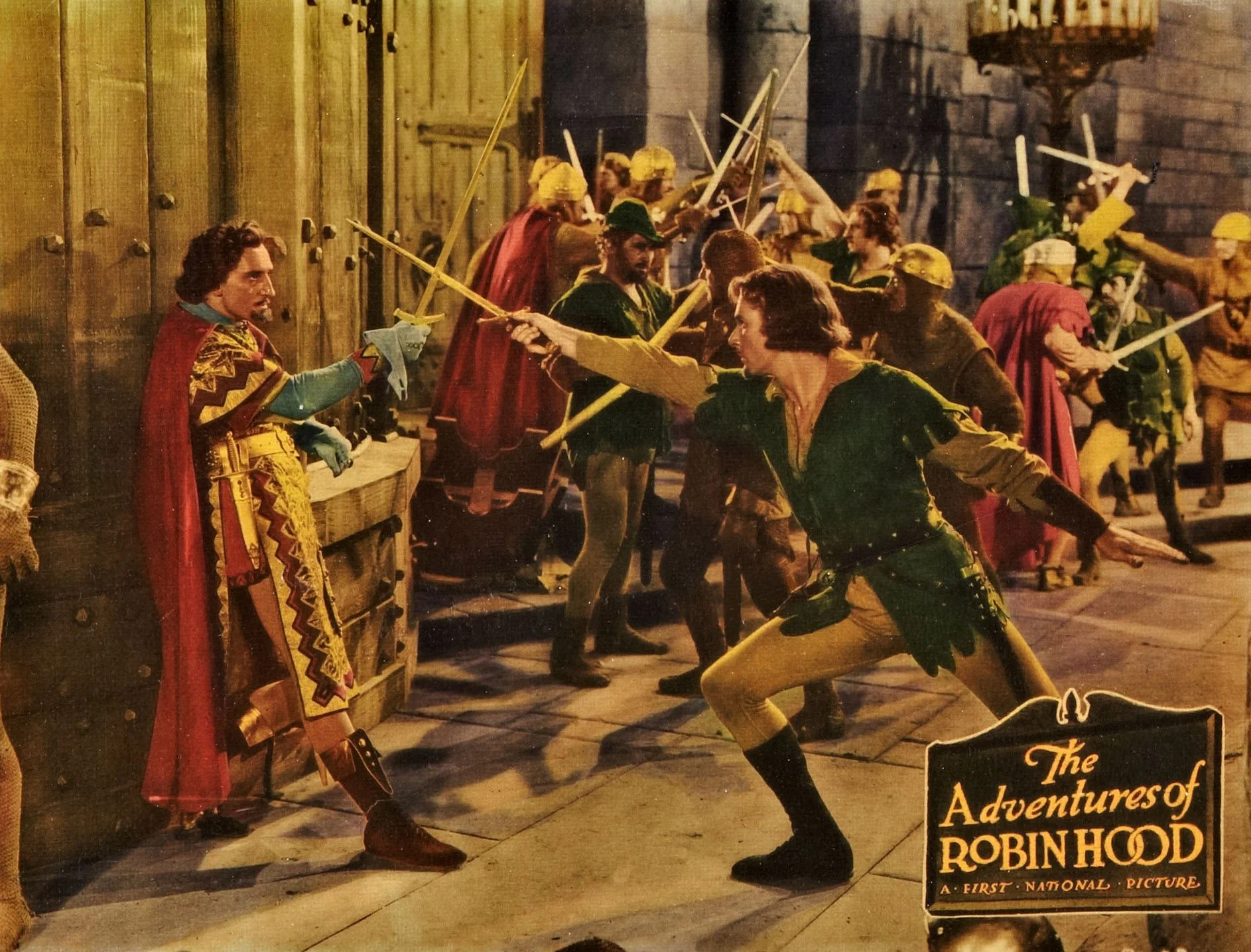
But I’d failed to notice that there’s a prior story I tell that also impinges on the best-known version of Robin Hood, the version popularized in 20th century movies like Errol Flynn’s and Douglass Fairbanks’—the version which derived from Sir Walter Scott’s 19th century romance Ivanhoe—the version set in the 12th century world of Richard the Lionheart, and his brother King John. — This narrative in my book which relates to Robin Hood is:
At the siege of Acre in 1191, during the Third Crusade, Richard the Lionheart supervised the building of siege engines to breach the walls of the city, and this led to its fall in July…. He immediately quarreled with Duke Leopold V of Austria over the spoils of war and eventually tore down Leopold’s banner and sent his army on their way…. In October…Richard left for England to stop his brother Bad King John (“Lackland”) from usurping him…. Richard…was making his way overland when he was captured by Leopold near Vienna on 20th December 1192…. Leopold was quite rightly excommunicated for this kidnapping by Pope Celestine III (imprisoning a crusader really did cross the line in the twelfth century) but he didn’t seem that bothered. He first imprisoned Richard in Dürnstein Castle and then sold him to the Holy Roman Emperor, Henry VI (who was also excommunicated). Henry demanded a ransom of 150,000 marks for the release of Richard…. Both clergy and laymen were taxed for a quarter of the value of their property, the gold and silver treasures of the churches were confiscated…. The English gathered [fifty] tons of silver…. On 20th December 1193, Queen Eleanor [of Aquitaine] set off [across Europe] with…the cash, arriving at Henry’s court on 17th January…and Richard was released….
The reason I hadn’t recalled that this 12th century history relates to a version of Robin Hood was because I got my memories of Robin Hood not from movies, but from reading Howard Pyle’s The Merry Adventures of Robin Hood, and that book hews to the oldest actual 14th century versions — which are not set in the Richard the Lionheart era. (Again, Walter Scott invented the 12th century Richard the Lionheart storyline in the 19th century.)
OK. The 12th century Richard the Lionheart storyline (and the 20th century movies), have this plot:
Robin Hood is a Saxon guy. His family is native to Britain.
But the king’s family—Richard and John—is Norman. They invaded and conquered Saxon Britain in 1066.
Robin Hood nevertheless was loyal to Richard the Lionheart.
However, while Richard is off doing Crusades, his brother King John imposes heavy taxes on the English. The reason for the new taxes is because, Richard was kidnapped and needs to be ransomed. Now, that’s a good reason to be excessively taxed, because King Richard is loved. But: King John is actually keeping the taxes for himself and for his evil cronies including, the Sheriff of Nottingham, plus a local nasty, Sir Guy. It’s in this context that Robin Hood becomes an outlaw, gathers his merry men, and fights the excessive taxation, partly by stealing from the rich to give to the poor.
So, then, Richard the Lionheart returns to England secretly, observes how his brother John has been abusing the people, witnesses Robin Hood’s correct ethics, as well as Robin Hood’s declared fealty to Richard himself, and then Richard reveals himself to Robin Hood, thanks him, and together all the good guys beat all the bad guys.
Well, now, comparatively speaking: in my book, check this out:
I tell, in detail, the story and folklore of the Mstislavl Rebellion, in 19th century Russia—where the Jewish community had involuntarily become part of the Russian empire because of a Great Powers deal the previous century called the Partition of Poland. The Mstislavl Rebellion episode involves excessive taxation, and tax evasion, and government corruption. It includes bad actors: the regional governor and the local sheriff (both Russian men named Engelghardt), plus a double-dealing Jewish informer, Ariya Briskin. The story involves unjust punishment for brave Jewish opponents to corruption (my ancestor, the notary Monos Leites; also the merchant Nota Frumkin), and other Jewish characters who stand up against corruption, in solidarity (Reb Itsele). And, this story involves a “good” Russian king, who sets thing to rights in the end because the Jewish good guys are loyal to him despite everything: Tsar Nicholas.
So, the Mstislavl Rebellion story has lots of Robin Hood corruption/justice plot points and characters! (The Erroll Flynn/Sir Walter Scott version, that is.)
An entire Robin Hood archetype buried in my book that I hadn’t noticed. I should put a sword fighting picture on the cover!